
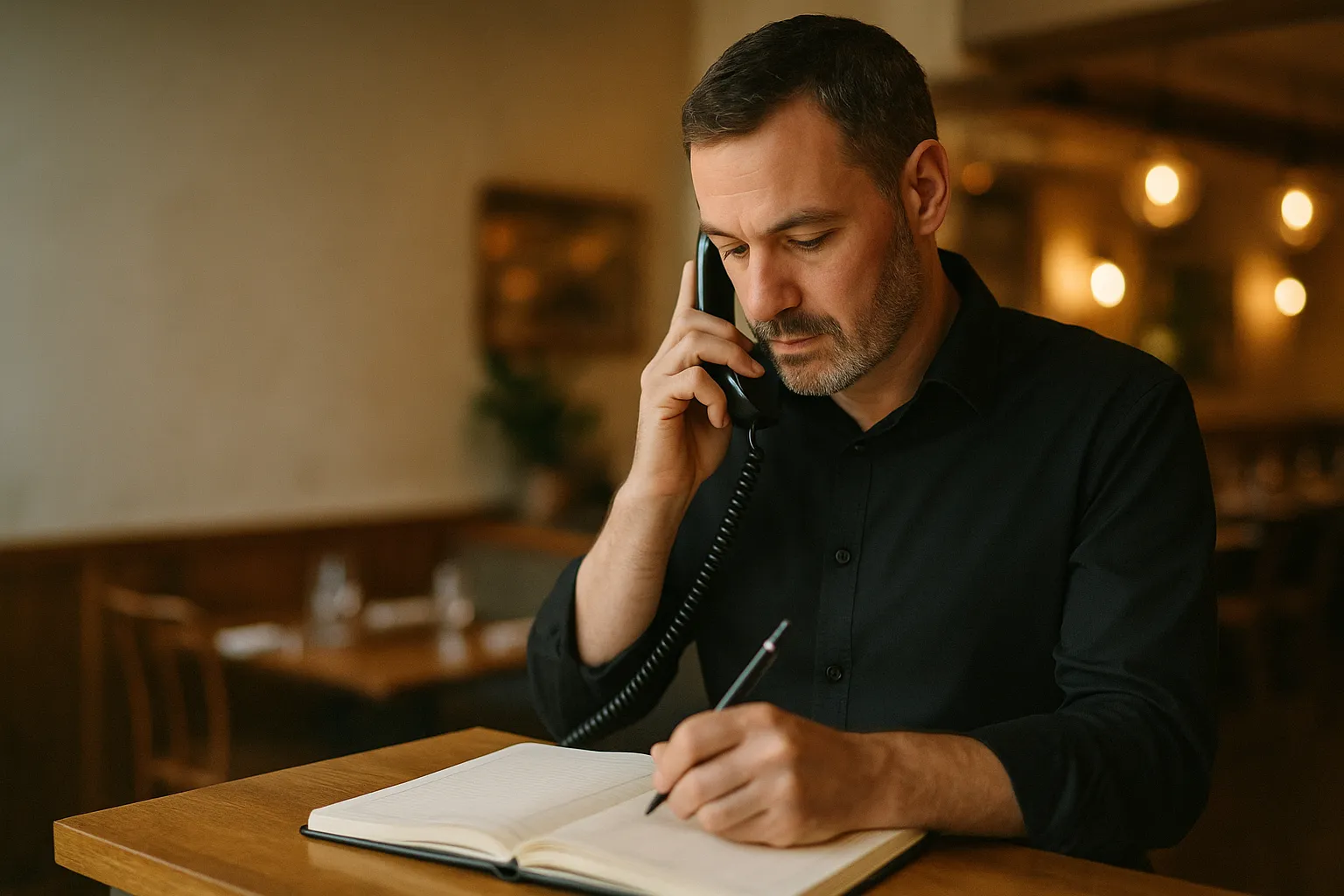
Both hands are full. The host is seating a four-top, the pass is calling, and the phone is on its fifth ring.
The problem
The phone rings mid-service
A restaurant does not miss calls out of carelessness. It misses them because the busiest hour on the phone is also the busiest hour in the room.
The caller moves on. A table for two on a Friday is a decision made in ninety seconds, and the next restaurant on the street is one tap away.
Half the calls are questions. Are you open Monday, do you have parking, is there a terrasse, do you take a party of ten. All of it already written down somewhere.
Calls arrive in clumps. Six at once at 17:30, then nothing until 21:00. You cannot staff for a shape like that.
Two languages, one phone. In Québec the caller may open in either, and switching should not depend on who happens to be nearest the handset.
The no-show. A table booked and never confirmed is a table you held for nobody on your busiest night.
How it works
How Alma answers a restaurant call
Answering the phone is the part of this that has been in production for a long time: thousands of business calls, in English and Quebec French, with hundreds of appointments booked out of them.
It answers on the first ring, through service. English or Quebec French, switching mid-call, and it takes six callers at once at 17:30 instead of leaving five of them on a ring.
It answers from your own material. Hours, address, parking, terrasse, group policy, what is on the menu you loaded, what you have written about allergens. It says what you wrote, and it does not invent a dish or a policy you never gave it.
It takes the reservation details and hands over what needs a person. Name, party size, date, time, the note about the high chair or the birthday. A complaint or a private-event enquiry goes to the manager instead of being handled by a machine.
Allergen questions are answered from your document, or not at all. If you have not written it down, it says it will have the restaurant confirm and passes the call or the message on. That is the right behaviour for a question where a wrong answer matters.
Capability
Built for restaurants
What is in the platform
Reservations, table management and phone orders are built into the platform. They are modules we developed for restaurants specifically, they ship with the product, and switching them on for your room is a setup conversation rather than a development project.
Reservations. Covers, date, time, party size and the notes that go with them, held against the guest rather than on a paper book that only exists at the host stand.
Table management. The room, the tables and what is assigned to them, so a reservation means a specific place to sit rather than a number in a list.
Phone orders. Taking an order over the phone as a structured record, with the items, the pickup time and the contact, instead of a name scribbled on the ticket rail.
What we will not do is show you a restaurant testimonial. The call answering, the texts, the courriels and the bookings are all in daily production use across our clients. The restaurant modules are built and available, and we would rather you judge them by trying them than by reading a quote.
The chain
After the call: confirmation and reminder
The after-the-call chain
The reservation is the easy half. The half that protects your Friday is what goes out afterwards, without anybody at the host stand doing it.
1. The booking is written down properly, with the party size, the time and the note, and the number that called becomes a contact you can reach again.
2. The guest gets a confirmation by text, in the language they called in, within seconds of hanging up. A guest with a confirmation in their pocket does not phone back to check.
3. A reminder goes out before the sitting. That is the cheapest thing anyone has ever done about no-shows, and it is the one nobody has time to do by hand at 17:30.
4. Changes and cancellations come back to the same place. The guest can reply to the text, and the table is freed while there is still time to sell it.
5. Group and private-event enquiries reach the manager by courriel with the details already collected, instead of as a message on a pad that gets read on Tuesday.
Beyond the call
The rest of the front office
The receptionist is the part you hear. Underneath it, AlmaTalk runs the rest of the front office: thousands of calls answered, hundreds of appointments booked, and the texts, courriels, files and invoices that follow them.
Texts and courriels, answered too. The same assistant sends and receives text messages and email for the business, so a caller who prefers to write gets the same answer.
Appointments and calendars. Bookings land in Google Calendar, Outlook or Apple Calendar during the call, with the confirmation and the reminder going out on their own.
Secure client files. Request a document, the client uploads it through a secure link, and it is filed against their record instead of living in somebody’s inbox.
Team messaging. Your staff talk in the same place the call records live, so the handoff does not happen in three different apps.
Invoices and online payment. Send the invoice and take the payment online, from the same client record.
Video meetings with AI notes. For the conversations that need a face, with the notes written for you.
Questions
Frequently asked questions
Can it take phone orders?
Phone orders are built into the platform, along with reservations and table management. They are modules made for restaurants and they ship with the product, so turning them on for your room is a setup conversation rather than something that has to be developed first.
Does it actually answer during service, or does it queue calls?
It answers all of them at once. That is the part a single host cannot do: at 17:30 the second, third and sixth caller are answered on the first ring rather than left ringing.
Does it know our menu?
It answers from the material you give it. Load the menu, the hours, the parking, the group policy and what you want said about allergens, and it says that. It will not invent a dish or a price you never gave it.
What about a caller with an allergy question?
It answers from what you wrote down. If the answer is not in your material, it says the restaurant will confirm and passes the call or a message to a person. A question where a wrong answer matters is one it hands over.
Does it answer in French?
Yes, in Quebec French, and it switches mid-call when the caller does. No press 1 for English. It also handles 30+ other languages.
What happens if somebody calls to complain?
It does not try to handle it. A complaint goes to the person you nominate, or is written up as a detailed message so a manager can call back knowing exactly what happened.
How does the guest get their confirmation?
By text message, in the language of the call, seconds after they hang up, with a reminder before the sitting. Sending and receiving texts and courriels is a part of the platform in daily use.
How do we try it?
Ring 1-888-775-9770 in the middle of your own rush and book a table. When you want it on the restaurant line, the free demo includes 1,200 credits, about 20 minutes of calls, and you keep your existing number.
Call it in the middle of your own rush
Ring the number below at 18:40 on a Friday and book a table for six. Change it to four, add an allergy, switch to French. That is the product picking up, not a recording.
Answered 24/7 in English and Quebec French. The free demo includes 1,200 credits, about 20 minutes of calls.
AlmaTalk is built by ALMA Intelligence Inc., a Canadian company based in Ottawa, Ontario. Processing, retention and deletion depend on the data and services enabled. Review our privacy policy for the details.