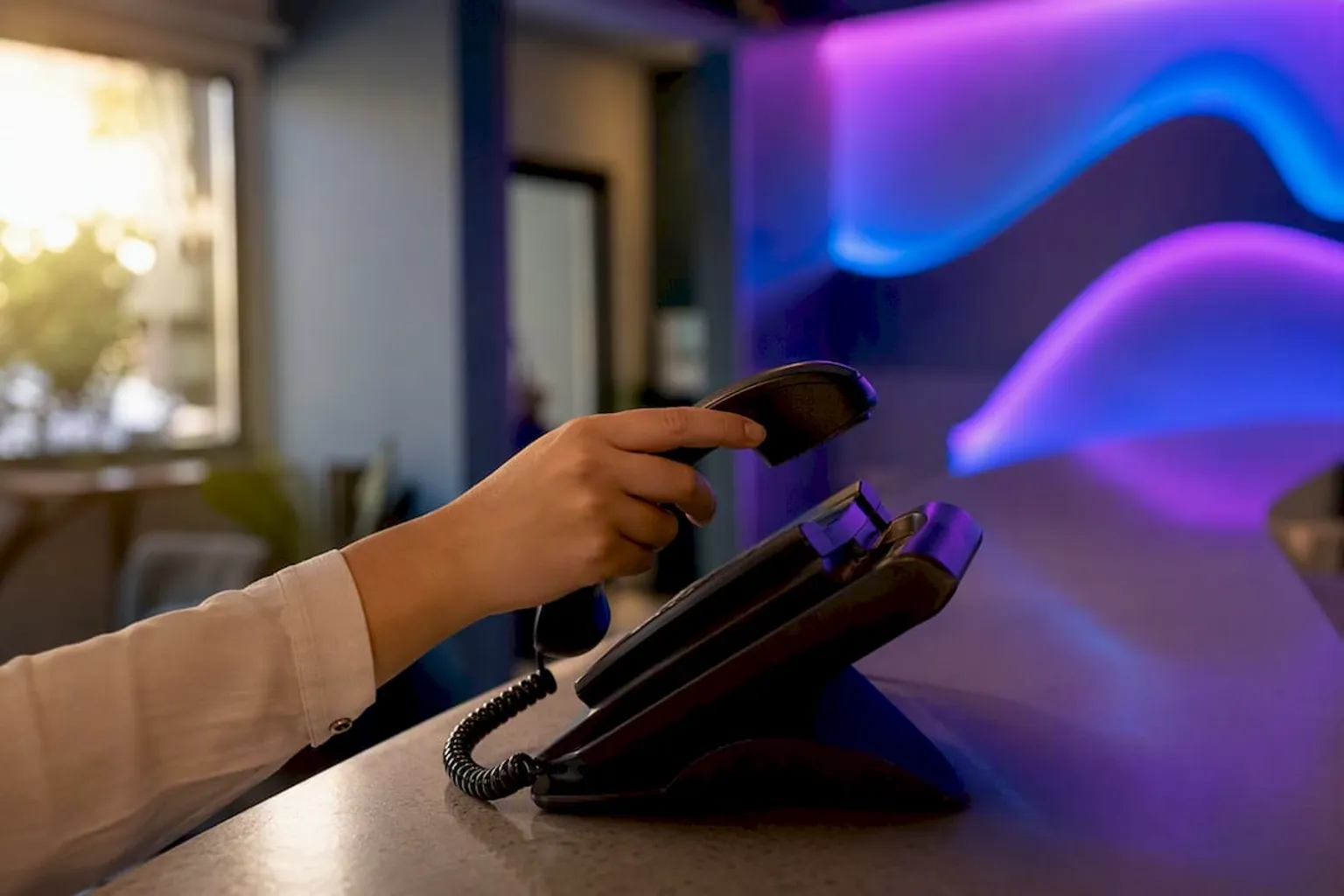



Six actions separate a professional phone call from one that costs you a customer: answer promptly, greet the caller with your business name and your own, speak clearly and a little slower than feels natural, confirm what you heard before you respond, ask permission before you put anyone on hold or transfer them, and close by saying what happens next and who owns it. That is the whole system. Everything below is the wording, the edge cases, and a way to check whether your team is actually doing it.
The six rules to post beside the phone
- Answer promptly, every time you are able to.
- Greet with your business name and your own name.
- Speak slightly slower than feels natural, and smile before you speak.
- Repeat back what the caller told you before you move forward.
- Ask “Do you mind if I put you on hold for a moment?” before you do it.
- End with a clear summary: what happens next, and who is responsible for it.
What phone etiquette actually means for a small business
Phone etiquette is the set of habits governing how your staff greet, listen to, transfer and follow up with callers, so the experience is consistent no matter who picks up. It is not a script read word for word. It is a framework with five parts: greeting, tone, clarity, conduct around hold and transfer, and a documented follow-up habit that closes the loop after the call.
Each part does specific work. The greeting sets expectations in the first two seconds. Clarity decides whether the caller has to repeat themselves, which is usually where frustration starts. Hold and transfer etiquette keeps them from feeling passed around like a parcel. And follow-up (the piece most businesses skip) is what turns one call into a returning customer. Whether you run a two-person plumbing outfit or a twelve-chair clinic, the mechanics are the same. Only the vocabulary changes.
Twelve rules your team can use on the next call
- Answer promptly. Six or seven rings while you finish an email tells the caller you are disorganised before you have said a word. Say: “Thanks for calling [Business Name], this is [Name], how can I help you?”
- Give both names. An anonymous “Hello?” leaves the caller unsure they dialled correctly. Say: “[Business Name], [Your Name] speaking.”
- Slow down. Most people speak faster on the phone because they cannot see the listener react. Slow down noticeably and you will sound composed, not scripted.
- Smile before you speak. The physical act changes your vocal tone in a way callers hear as warmth. A sticky note on the phone reading “Smile, then speak” sounds silly and works.
- Use the caller’s name once you have it. Once or twice in a call personalises it. Every sentence sounds scripted. Say: “Thanks, Sarah. Let me check that for you.”
- Ask before you place someone on hold. Silence without warning feels like abandonment. Say: “Would you mind holding for about a minute while I check?”
- Explain a transfer before you make it. Say: “I’m going to connect you with Mike in billing, because he can sort this out faster than I can.” A caller passed around blind loses trust quickly.
- Practise active listening, not passive waiting. Confirm before you solve. Say: “So if I understand correctly, the March invoice is the one showing the error?”
- Take notes during the call, not after. Memory fades the moment you move to the next task.
- Retire slang and filler. “Yep,” “no worries” and “uh huh” chip away at a professional tone even when meant kindly.
- Use speakerphone only when there is a reason. Echo makes you sound distracted, and anyone in earshot hears the caller’s details.
- Close by confirming next steps. Say: “So I’ll email you the quote by end of day and follow up Thursday if I haven’t heard back. Does that work?”
Phrases and habits that cost you trust
Interrupting is the costliest habit of all, because it tells the caller you decided what they needed before they finished saying it. Letting them finish is a baseline requirement, not an aspirational nicety. Here are phrases worth retiring, with a replacement for each:
- Instead of “You’ll have to call back later” → “Can I take your number and have someone call you back within the hour?”
- Instead of “That’s not my department” → “Let me connect you with the right person, one moment.”
- Instead of “I don’t know” → “Let me find out and get back to you today.”
- Instead of silence after hitting hold → “I’ll be back with you in about two minutes.”
- Instead of “Calm down” → “I understand this is frustrating. Let’s fix it.”
Privacy mistakes deserve their own line, because they are harder to undo than a rude tone. Do not read a customer’s full account number, date of birth or payment details aloud where other callers or colleagues can hear. Confirm you are speaking to the right person before you share anything account-specific. A caller phoning on behalf of a spouse or an employer is common and entirely reasonable, but it is still a verification step. Canadian businesses handling customer information in the course of commercial activity are covered by PIPEDA, and provincial privacy or health-information rules may apply on top of it. Rules differ by situation and by province; this is not legal advice.
Voicemail, and how fast to call back
One business day is a reasonable callback standard for most small businesses, with a same-day callback for anyone who sounds ready to buy. A workable cadence: one business day for general enquiries, two to four hours for a new lead, and a text or email if two attempts go unanswered.
A good voicemail greeting names the business, gives a sense of when you will respond, and says exactly what to leave. Skip the apology loop: “You’ve reached [Business Name]. Please leave your name, number and reason for calling, and we’ll return your call within one business day.”
What never belongs in a voicemail you leave for a customer: account numbers, balances or payment amounts; medical, legal or otherwise sensitive details; and internal staff names or extensions that have nothing to do with the caller’s issue. State that you are returning their call, give a callback number, and stop there.
The habit that quietly ruins all of this is promising a callback and not delivering it. If you said 3 p.m., either call at 3 p.m. or send a short message explaining the delay. Log every call, answered or missed, in whatever system you use to track customers. A shared spreadsheet counts. If most of your missed calls are landing in voicemail after hours, it is worth reading how voicemail compares with an answering system that actually talks to the caller.
De-escalating an upset caller in four steps
Acknowledge the feeling before you try to solve anything. Validating frustration first makes callers more receptive to the solution that follows, because they stop fighting to be heard and start listening.
- Acknowledge. “I understand why you’re frustrated. That shouldn’t have happened.” Do not defend the business yet. Just name the emotion.
- Apologise. “I’m sorry for the trouble this has caused you.” A genuine apology does not require admitting fault; it requires admitting impact.
- Offer options. “Here’s what I can do right now.” Then give one or two concrete choices rather than a vague promise to look into it.
- Confirm next steps. “So I’ll process the refund today and email you confirmation by 5 p.m. Does that work?” Ending vaguely undoes the trust you just rebuilt.
Escalate to the owner when the caller asks for a supervisor, when the fix exceeds the front desk’s authority, or when the same complaint arrives twice from the same person.
Train it in a week, then measure it
Fifteen minutes twice a week beats a two-hour workshop once a quarter, because the skill has to become reflexive under real call pressure. Day one: share the six rules, one role-play per person. Days two to four: each person listens back to two of their own calls for pace, clarity and whether they asked before holding. Day five: five minutes of group review per person, focused on one improvement each. After that, spot-check one call per person per week against the table below.
| QA item | What to check | Pass criteria |
|---|---|---|
| Greeting | Business name and staff name stated in the first two seconds | Present in the call you sampled |
| Clarity | Caller does not have to repeat information | No repeat requests |
| Hold and transfer | Permission asked before hold; reason given before transfer | Both stated out loud |
| Close | Next steps and contact details confirmed before hanging up | Explicit summary stated |
| Follow-up | Call logged and callback completed within the promised window | Logged the same business day |
Track three numbers rather than everything: answer rate (the share of calls picked up before voicemail), how long it takes to answer, and callback reliability (the share of promised callbacks completed on time). Coach one of them per session: narrow feedback sticks, a list of every flaw does not. Clinics running the same drill on intake calls can borrow the worked version in our guide to handling new-patient calls at a busy clinic. Structured, reusable framing removes the guesswork of what to say first, which is what a new hire needs in week one.
Where AlmaTalk fits
Etiquette only helps on the calls someone picks up. If your line rings while you are on a roof, under a sink or with a patient (or after 6 p.m., or in French when your front desk works in English), the rules above have nobody to apply them.
That is the gap AlmaTalk’s AI receptionist is built for. It answers 24/7 in more than 30 languages with automatic language detection, and its core pair is Canadian English and Quebecois French, so a caller who switches to French is not handed a language barrier. It follows the same shape as the rules above: a consistent greeting, a confirmation of what the caller asked for, a booking straight into your Google Calendar, Outlook or Cal.com during the call, an SMS or email follow-up afterwards, and a transfer to a human with ranked backup numbers when the call needs one. It remembers returning callers, records the call, and sends a daily summary, which gives your weekly QA check something to review. Across a recent 90-day window, calls averaged 80 seconds over 2,639 answered calls.
Starter is $97.97 CAD a month for 150 minutes, Pro $247.97 CAD for 400 minutes, billed by the second, with no setup fee and no per-call fee. The plainest way to judge the etiquette is to be the caller: the demo line is 1-888-775-9770, and anyone can ring it. If a bilingual front desk is the problem, start with the bilingual receptionist page; if it is daytime calls going unanswered, start with phone answering for Canadian businesses.
Frequently asked questions
What is the biggest phone etiquette mistake small businesses make?
Letting the line ring out to voicemail during business hours. It is the fastest way to lose a caller who has other options and no loyalty to you yet. The second-biggest is promising a callback and not making it.
How many rings should a business phone go unanswered?
Aim to answer by the third ring. Past that, callers start assuming nobody is there, and many hang up before voicemail even picks up. If three rings is unrealistic during your busiest hours, decide in advance who is the backup for the phone.
How quickly should a small business return a missed call?
Within one business day for general enquiries, and within a few hours for anyone who sounds like a new lead ready to buy. Track the share of promised callbacks you actually complete on time; it is a more honest measure of your phone standards than anything else you can count.
What should never go in a voicemail left for a customer?
Account numbers, balances, payment amounts, and medical or legal details. Say that you are returning their call, leave a callback number, and stop there. The same rule applies to reading account details aloud where other people can hear.
Can an AI receptionist follow the same etiquette rules?
It can hold the same greeting, listening and follow-up standard on the calls it answers, at any hour, without the fatigue that erodes human consistency over a long shift. AlmaTalk answers 24/7 in over 30 languages, books into Google Calendar, Outlook or Cal.com during the call, and transfers to a human with ranked backup numbers. Call the demo line at 1-888-775-9770 and judge the etiquette as a caller.